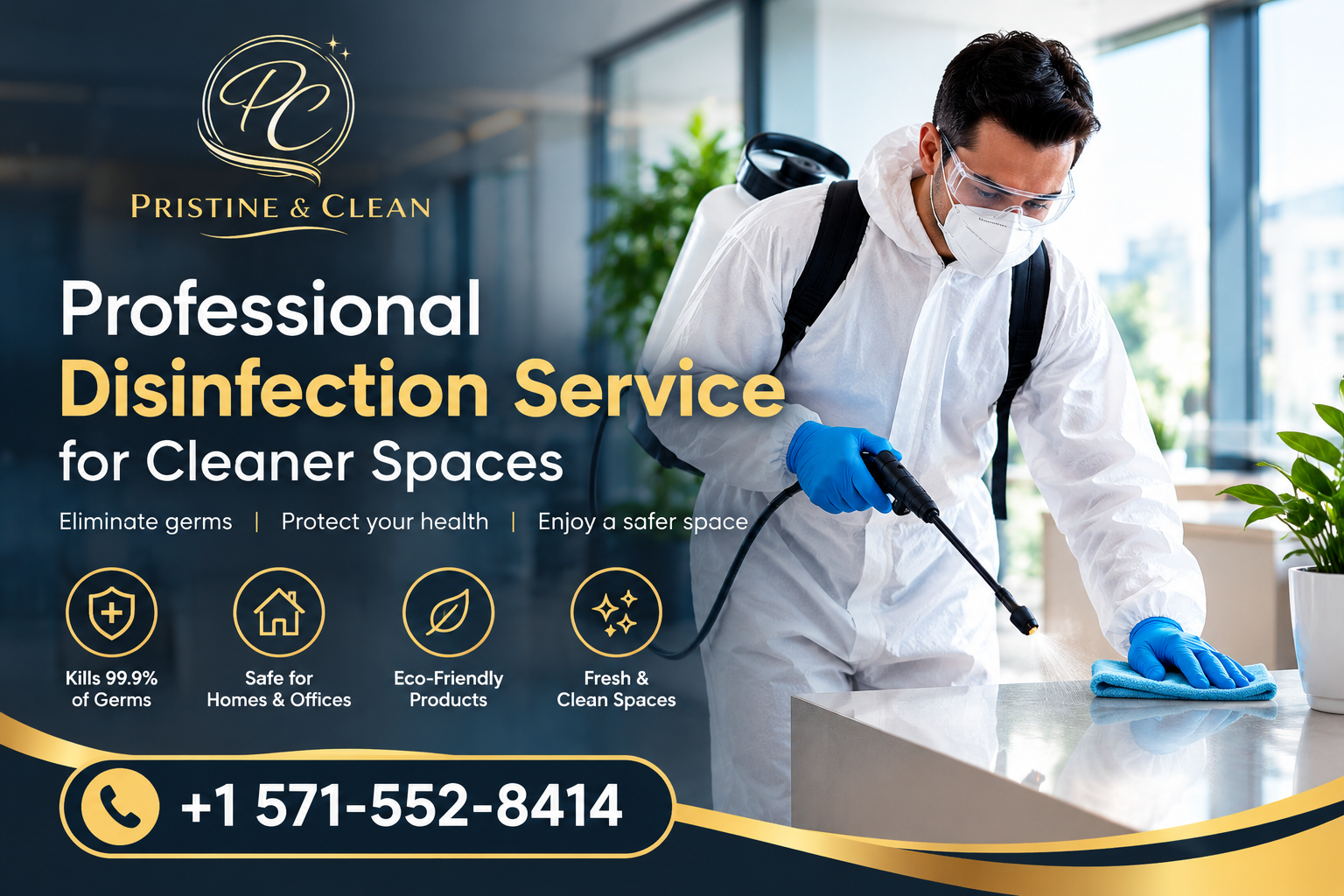
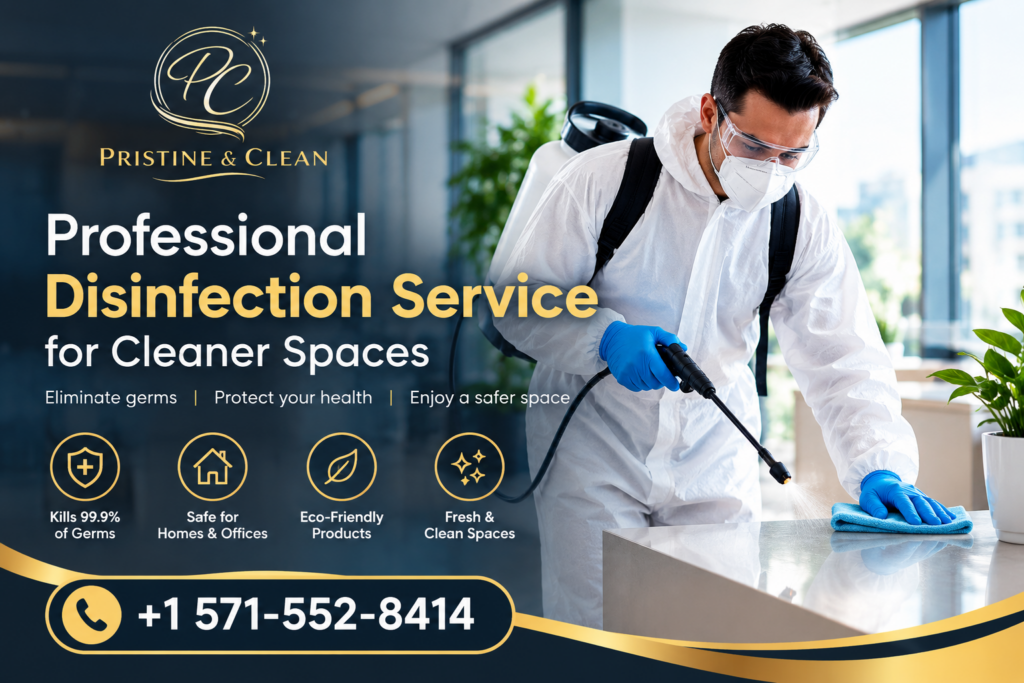
A professional disinfection service helps reduce harmful germs on frequently touched surfaces in homes, offices, commercial buildings, and other shared environments. While routine cleaning removes dirt and many germs, professional disinfection adds an important step when a space needs additional attention after illness, contamination, or increased exposure.
For businesses and property owners, maintaining clean and hygienic surroundings is about more than appearance. A well-planned cleaning and disinfection program can support healthier environments while giving employees, customers, residents, and visitors greater confidence in the cleanliness of a property.
What Is a Professional Disinfection Service?
A professional disinfection service is a specialized cleaning service designed to clean surfaces and apply appropriate disinfecting products according to their labels and intended uses.
Professional technicians typically focus on high-touch areas such as:
- Door handles and push plates
- Light switches
- Desks and countertops
- Elevator buttons
- Shared equipment
- Restroom fixtures
- Tables and chairs
- Handrails
- Touchscreens and frequently used devices
The process generally begins with cleaning. This is important because dirt and other materials can interfere with the effectiveness of disinfectants. The CDC recommends cleaning surfaces before sanitizing or disinfecting them.
Disinfection is different from cleaning. Cleaning removes dirt, impurities, and many germs from surfaces, while disinfection uses products designed to kill harmful germs that remain on surfaces.
Why Is Professional Disinfection Important?
Everyday environments can contain numerous high-touch surfaces that are handled repeatedly throughout the day. Offices, schools, restaurants, gyms, apartment buildings, and commercial facilities can therefore benefit from consistent cleaning practices.
However, not every situation requires extensive disinfection. The CDC notes that in many ordinary circumstances, routine cleaning is sufficient. Disinfection becomes particularly relevant when someone has been sick, when contamination has occurred, or when the characteristics of a facility justify additional measures.
A professional approach can help organizations establish a more consistent process rather than relying on occasional surface spraying.
When Should You Consider a Disinfection Service?
There is no single schedule that works for every property. The appropriate frequency depends on occupancy, traffic, surface use, the type of facility, and whether illness or contamination has occurred.
A professional disinfection service may be useful after:
- An employee, customer, resident, or visitor has been ill
- A property has experienced a contamination incident
- A high-traffic commercial space needs additional surface disinfection
- A business is preparing to reopen after a temporary closure
- Shared workspaces require additional hygiene measures
- A property manager wants a structured cleaning and disinfection program
High-touch surfaces deserve particular attention because they are handled frequently. CDC facility guidance recommends regularly cleaning high-touch surfaces and disinfecting areas where people have obviously been ill.
Professional Disinfection vs. Routine Cleaning
Cleaning and disinfection work together, but they are not the same thing.
| Cleaning | Disinfection |
| Removes dirt and impurities | Kills harmful germs remaining on surfaces |
| Usually uses soap, detergent, and water | Uses an appropriate disinfecting product |
| Should be performed routinely | Used when additional germ reduction is appropriate |
| Improves surface cleanliness | Provides an additional hygiene step |
A quality disinfection service should not simply spray chemicals throughout a building. The process should consider the surface, the product label, appropriate contact time, ventilation, and safe handling procedures.
How Does a Professional Disinfection Service Work?
A professional service generally follows a structured process.
1. Assess the Space
Technicians identify the property’s size, layout, surface types, traffic patterns, and areas requiring special attention.
2. Clean Surfaces First
Visible dirt and debris should be removed before applying disinfectant. This allows the disinfecting product to work as intended.
3. Identify High-Touch Areas
Technicians prioritize surfaces that are frequently handled, including handles, switches, counters, rails, shared equipment, and other commonly touched areas.
4. Apply the Appropriate Product
The disinfectant should be suitable for the specific surface and intended use. EPA guidance emphasizes using registered disinfectants according to their label directions.
5. Observe Contact Time
One of the most important parts of professional disinfection is contact time. The surface generally needs to remain visibly wet for the period specified on the product label for the relevant pathogen.
6. Complete a Safety Check
After treatment, technicians follow appropriate procedures for ventilation, chemical storage, personal protective equipment, and other safety requirements.
This structured process helps make disinfection more consistent and reduces the risk of improper chemical use.
What Products Are Used for Disinfection?
The products used depend on the property, surfaces, microorganisms of concern, and product labeling.
In the United States, the EPA maintains resources identifying registered disinfectants and their approved uses. EPA’s current List N tool allows users to search products by factors such as active ingredient, use site, surface type, and contact time. The tool was updated on September 15, 2026.
Importantly, disinfectants are intended for surfaces unless the product specifically has another approved use. EPA states that List N products are for surfaces, not humans.
Professional technicians should therefore follow the product label instead of assuming that every disinfectant can be used in the same way.
Why Contact Time Matters
Contact time is often overlooked when people attempt DIY disinfection.
A product may require a surface to stay wet for a specific period before it can effectively perform its labeled antimicrobial function. Wiping the product away too quickly can prevent the required contact time from being achieved.
For this reason, effective professional disinfection involves more than choosing a strong chemical. It requires following the manufacturer’s instructions for dilution, application, surface compatibility, and contact time.
Safety Comes First
Disinfecting chemicals can present hazards when used incorrectly. Mixing different cleaning chemicals can create dangerous reactions, while excessive exposure can irritate the eyes, skin, or respiratory system.
The CDC recommends following product labels, using appropriate protective equipment, maintaining suitable ventilation, and never mixing cleaning or disinfection products with one another.
A professional service should also consider:
- Product label requirements
- Safety Data Sheet information
- Appropriate PPE
- Ventilation
- Surface compatibility
- Safe chemical storage
- Proper dilution
- Required contact time
Consider whether the company:
Where Can Disinfection Services Be Used?
These practices are especially important in occupied commercial environments.
A professional disinfection service can be adapted for many environments, including:
Offices and Workplaces
Shared desks, conference rooms, break areas, restrooms, door handles, and other high-touch areas can receive targeted attention.
Residential Properties
Homes and apartments may require additional disinfection following illness or specific contamination concerns.
Schools and Childcare Facilities
Shared surfaces and high-touch areas may require carefully planned cleaning and disinfection procedures. However, schools and childcare environments can have specific requirements that should be followed.
Retail and Commercial Spaces
Customer-facing areas, checkout surfaces, handles, counters, and shared equipment can be included in a customized cleaning plan.
Gyms and Shared Facilities
Exercise equipment, touchpoints, locker areas, and other frequently handled surfaces may require regular cleaning and appropriate disinfection.
Healthcare facilities and certain specialized industries may have additional regulatory requirements. CDC facility guidance specifically notes that its general community-setting recommendations are not intended to replace requirements applicable to healthcare and other specialized facilities.
How to Choose a Professional Disinfection Service
When comparing a cleaning company, look beyond the word “disinfection.” Ask how the service is actually performed.
- Explains its cleaning and disinfection process clearly.
- Uses products appropriate for the surfaces being treated.
- Follows product label instructions.
- Understands contact time requirements.
- Trains workers in safe chemical handling.
- Uses appropriate protective equipment.
- Can customize the service according to the property’s needs.
- Clearly explains what is included in the service.
A professional provider should be transparent about its methods rather than making unrealistic claims about eliminating every germ from an environment.
Professional Disinfection Service for a Healthier Environment
Disinfection should be part of a broader hygiene strategy rather than viewed as a replacement for everyday cleaning.
Routine cleaning, hand hygiene, appropriate ventilation, waste management, and targeted disinfection can work together to support a cleaner environment. The CDC emphasizes that regular cleaning and appropriate disinfection can help reduce the spread of illness-causing germs.
For property owners and businesses, a professional service can also make the process more organized. Instead of relying on inconsistent cleaning practices, a planned service can identify priority areas and establish repeatable procedures.
Why Choose Pristine and Cleaning?
Pristine and Cleaning provides professional cleaning solutions designed around the needs of residential and commercial properties. A customized approach can help address high-touch surfaces, shared spaces, and areas requiring additional attention.
The goal should always be practical: clean the space properly, use suitable products, follow safety instructions, and provide a consistent service based on the property’s requirements.
For businesses and property owners looking for a professional disinfection service, Pristine and Cleaning can help develop a cleaning approach suited to the space and its day-to-day use.
FAQs
What does a professional disinfection service include?
A professional disinfection service typically includes an assessment of the space, cleaning of surfaces, targeted treatment of high-touch areas, application of an appropriate disinfectant, and adherence to required contact times and safety procedures. The exact scope depends on the property, surfaces, and reason for disinfection.
How often should professional disinfection be performed?
There is no universal schedule. Frequency depends on traffic, occupancy, surface use, facility type, and whether someone has been sick. Routine cleaning should remain part of the overall plan, while additional disinfection may be appropriate following illness or contamination. CDC guidance recommends regularly cleaning high-touch surfaces.
Is professional disinfection better than cleaning alone?
Cleaning and disinfection serve different purposes. Cleaning removes dirt and many germs, while disinfection uses appropriate products to kill harmful germs remaining on surfaces. In many everyday situations, cleaning alone may be sufficient, but additional disinfection can be appropriate when someone has been sick or contamination has occurred.
Can a professional disinfection service eliminate every germ?
No service should promise complete elimination of every microorganism from an environment. Effective disinfection depends on the product, surface, microorganism, application method, and required contact time. Professional technicians should follow product labels and applicable safety guidance rather than making absolute claims.
Conclusion
A professional disinfection service can provide an organized approach to reducing harmful germs on frequently touched surfaces when additional disinfection is appropriate. The most effective process starts with proper cleaning, uses a suitable disinfectant, follows label directions, observes contact time, and prioritizes worker and occupant safety.
For homes, offices, and commercial properties that need additional cleaning and disinfection support, Pristine and Cleaning can help create a service plan based on the property’s specific needs.
Contact Pristine and Cleaning to learn more about professional cleaning and disinfection options for your space.